

Welcome to Zealots of Zaldar
Zealots of Zaldar is a tabletop adventure/role-playing game for 2 to 5 players. One player takes on the role of Zaldar, the unseen sorcerer who guides and referees the game. The other players take on the roles of Heroes, customized characters who explore and interact with the world of Emara.
This guide is streamlined for online play, so much of the detail relevant to the Zaldar player has been omitted.
Getting Started
Before starting Zealots of Zaldar, one player must be designated as Zaldar. This player will be responsible for running the game: directing the flow of activity, describing the outcome of actions, and acting as the referee and conductor of the game's events.
In other games with a similar referee vs. player dynamic, the Zaldar or "referee" player is known as the "Dungeon Master" (Dungeons & Dragons), "Game Master" (GURPS), "Zargon" (HeroQuest), and so on. In Zealots of Zaldar and throughout the rulebook, this player is simply known as Zaldar. Zaldar controls the game world of Emara, and determines how the world and its denizens react to the Heroes' actions and dice rolls.
Once a Zaldar player is designated, the other players create Heroes. These players decide how their Hero characters interact with the game world, including what they say, the actions they perform, and any other details a player wishes to impart upon their Hero.
Creating Characters
To create Hero characters, Zaldar will hand each Hero player a blank Character Sheet. Players may begin the game immediately using one of the ready-to-play Level 1 Hero characters, or spend Character Points to advance beyond Level 1 before the game session, at Zaldar's discretion.Character Sheets
The character sheet is an ongoing record of a Hero's status. It contains basic information about the character, as well as their skills, stats, and so on.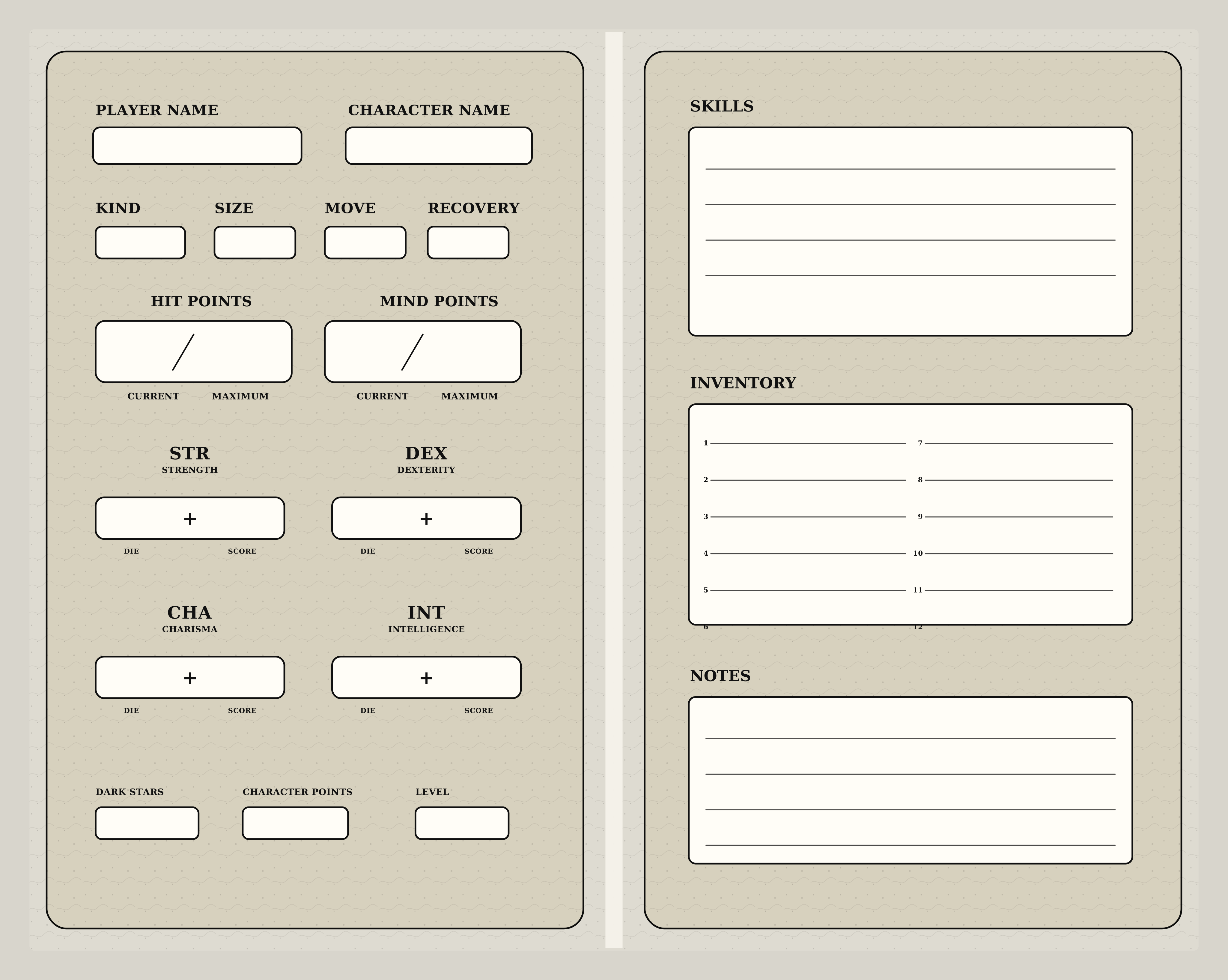
Name, Figurine
This is the name of the Hero, which can be anything the player chooses, along with the figurine used to represent the Hero. The figurine shortname will be something like "ORC 1," "HUM 2," and so on.Level
This represents the Hero's growth, progress, learning, and overall capabilities. In general, a character or creature with a high level will be particularly strong, smart, or otherwise powerful.Kind
Kind refers to one of the 5 playable creature types. The five options available for Hero characters are Dwarf, Elf, Goblin, Human, and Orc, whose various stats are described below.Size
Size is a number that represents the character's overall height and general mass. It is always a multiple of 10, and roughly corresponds to height: a Size of 60 is approximately 6 feet tall. Each Kind has a base Size listed in its stat table.HP (Health Points)
HP or Health Points / Hit Points are a measure of a character's current overall physical health. Whenever a character takes damage (e.g. from a punch, stab, explosion, bite, bludgeon, and so on), their Current HP is reduced.A character whose Current HP value is the same as their Maximum HP value is considered to be functioning physically at their top form; whereas a character with 1 HP has likely suffered multiple severe injuries, and is very close to being unconscious.
MP (Mind Points)
MP or Mind Points represent a character's overall mental state, as well as their ability to focus closely on tasks.STR
STR is short for Strength, and represents a character's raw physical strength, as well as the amount of weight they can lift and carry.DEX
DEX is short for Dexterity, and represents a character's ability to dodge and defend themselves from physical attacks, their general physical agility, and so on.CHA
CHA is short for Charisma, and represents a character's ability to communicate effectively, persuade others, lead and inspire people with speech, as well as lie and deceive.INT
INT is short for Intelligence, and represents a character's perception, ability to understand difficult concepts, arcane knowledge, and so on.Equipment Requirements
A character who does not meet a weapon's or armor's stat requirements cannot equip it.Move
This represents how many spaces on the game board a character may walk on their turn. There are many different ways of moving around -- walking, running, jumping, crawling, and so on -- which are outlined in the Movement section of the rulebook.Action Points
Action Points or AP represent things a character can do on their turn that aren't related to traveling around: talking, attacking, searching, casting spells, digging holes, opening doors, and so on. The various actions have varying AP values, as detailed in the Actions section of the rulebook.Recovery
This represents the minimum number on a d20 that must be rolled in order to recover after being knocked out. Each Kind has a base Recovery value (shown as a number followed by "+", e.g. "15+" means the character must roll 15 or higher on a d20). A lower Recovery value is better, as it makes recovery easier. Recovery can be improved by spending 2 Character Points to reduce it by 1, to a minimum of 10.When a character is Down (reduced to 0 HP), they may attempt a Recovery Roll at the start of each turn. When a character is Unconscious (from rolling a 1 on a Down Recovery Roll), they may attempt a Recovery Roll once every 30 rounds (Quest Mode) or once per hour (Campaign Mode). See the Recovery action and the Down and Unconscious statuses for full details.
Dark Stars
Dark Stars are rewarded by Zaldar throughout the game sessions. Sometimes, they are explicitly listed in the Quest Book as rewards for finding hidden things and achieving certain tasks. Other times, Zaldar may choose to give a Dark Star to a player if they have done something particularly impressive, or otherwise played in a way that enhances the game's enjoyment or immersion for all participants.Any player may, at the conclusion of their turn or another player's turn, spend a Dark Star to immediately take a full turn. Only one Dark Star extra turn may occur per round, across all players.
A Down character may also spend a Dark Star to Recover automatically instead of rolling — see the Recovery action.
For example, if Susie takes a turn in the normal turn order, then Doug takes a turn, Susie may spend a Dark Star to take an extra turn after Doug. No other player (including Susie) may spend a Dark Star for an extra turn until the Heroes' next round.
Character Points
Character Points are used to advance a Hero's Level. They are rewarded based on accomplishing goals in the campaign, as described in the Quest Book or in Zaldar's notes if running a custom campaign.At any time, a Hero may exchange 3 Dark Stars for 1 Character Point.
Inventory
This is a listing of all the items, weapons, armor, and other goods a Hero has on their person.Without any containers (backpacks, belt pouches, quivers, etc.), a character can only carry what they can hold in their two hands — one item per hand. To carry additional items, a character must acquire a container such as a Backpack, Utility Belt, or Quiver, each of which has its own capacity. See the Wearables section for available containers and their limits.
Skills
This section lists all the unique Skills a Hero can perform. These are described in greater detail in the Skill section of this rulebook.Notes
This is an area for any miscellaneous information a player may wish to jot down -- conversations had with other characters, secret codes, and so on.Hero Creatures
| HP | MP | Move | Size | Recovery |
|---|---|---|---|---|
| 12 | 3 | 5 | 40 | 10+ |
| STR | DEX | CHA | INT |
|---|---|---|---|
| d6 + 2 | d4 + 1 | d8 + 2 | d6 + 4 |
First Aid - Basic
| HP | MP | Move | Size | Recovery |
|---|---|---|---|---|
| 8 | 4 | 7 | 50 | 14+ |
| STR | DEX | CHA | INT |
|---|---|---|---|
| d4 + 1 | d6 + 2 | d4 + 1 | d8 + 3 |
Perception - Basic
| HP | MP | Move | Size | Recovery |
|---|---|---|---|---|
| 5 | 3 | 8 | 30 | 12+ |
| STR | DEX | CHA | INT |
|---|---|---|---|
| d4 + 1 | d8 + 2 | d6 + 2 | d6 + 3 |
Trickery - Basic
| HP | MP | Move | Size | Recovery |
|---|---|---|---|---|
| 9 | 4 | 6 | 60 | 13+ |
| STR | DEX | CHA | INT |
|---|---|---|---|
| d6 + 2 | d6 + 2 | d6 + 3 | d6 + 3 |
Persuasion - Basic
| HP | MP | Move | Size | Recovery |
|---|---|---|---|---|
| 10 | 1 | 6 | 80 | 11+ |
| STR | DEX | CHA | INT |
|---|---|---|---|
| d8 + 2 | d6 + 2 | d4 + 0 | d4 + 2 |
Counterattack - Basic
Gameplay
Once the Heroes have filled out their character sheets, they're ready to play. The Quest Book contains all the details necessary for Zaldar to run the included Dawn of the Dark Star campaign. Starting at Quest 1: Midnight in Moonshine Ravine, Zaldar introduces the narrative, and the players immediately start the Quest.The game alternates between the turn-based Quest Mode, which takes place on the Quest Mat, and the Campaign Mode, a more free-form conversational role-playing format. In both cases, the core of the gameplay remains the same: Zaldar provides details about the Heroes' current circumstances, the Heroes react to and engage with those circumstances, and Zaldar reveals the outcome. This continues for the entirety of the game session.
Game Sessions
Unlike a game of Chess or Checkers in which one participant triumphs, Zealots of Zaldar is an episodic game, in which the characters and game state persist over numerous game sessions. It's unrealistic to play through an entire campaign in one sitting, so instead, break the campaign into smaller game sessions.While everyone's preferences differ, a suggested format for a Zaldar game session is two hours in length, with a 5-minute intermission after one hour. This is sufficient time to cover a lot of territory given your game group's play speed, but not so long that it's an unreasonable ask on a weekday night. You should always consider the game participants' time to be of the highest importance, and as Zaldar, you have the most control over how the game time is spent. Spend it well, and you and your players will be hungry for more!
You don't necessarily have to finish a Quest, or achieve some other specific objective, in order to end a game session. If there's more to explore on the Quest Map, record on a Notes sheet the current status of the gameboard: the rooms visible, the coordinates of the characters, and any other pertinent details. This will allow you to quickly resume gameplay at the next game session. (For Roll20 online play, this is not a concern.)
Rounds & Turn Order
In Quest Mode, gameplay is divided into rounds. Each round consists of two phases: the Heroes' phase, followed by Zaldar's phase.During the Heroes' phase, each Hero takes one turn. The Hero players collectively decide the order in which they act, and they may change this order from round to round. Once every Hero has taken a turn, the Heroes' phase ends and Zaldar's phase begins. Zaldar then takes turns for all creatures and characters under his control. When Zaldar's phase is complete, a new round begins.
In Campaign Mode, there is no formal turn order. Zaldar directs the flow of conversation, and players act and react as the narrative demands.
On a Hero's Turn
On a Hero's turn, they may Move and perform Actions.By default, all characters have 3 Action Points they may spend per turn. They can also move as many spaces as indicated by their MOVE.
There are numerous different types of movement, including Running, Swimming, Jumping, and more. These are detailed below.
Direction Die
The Direction Die is a d4, with the values N, S, E, and W. It is used to determine a random direction on the Quest Mat whenever one is needed, such as when a thrown object misses its target and veers off course, or when a creature moves erratically (e.g. a shambling Zombie).Critical Hit Die
The Critical Hit Die is a black d6, with four blank faces and two faces bearing a white "CRITICAL HIT" icon. It is rolled when a character uses the Aim / Focus action, alongside their Attack, Defend, or Skill roll. If a CRITICAL HIT face comes up, the roll's total is doubled. See Aim / Focus for full details, including Chained Criticals.Facing
Every character on the Quest Mat faces one of the four cardinal directions: N, S, E, or W. A character's facing is represented by the orientation of their figurine on the board.Changing which direction your character faces costs 0 Move Points and can be done freely at any time during your turn. When a character attacks, both the attacker and the target are considered to be facing a specific direction at the moment of the attack.
Because changing facing is free, it is trivial to face an opponent before attacking them. Facing matters primarily for determining Back Attacks and Flank Attacks (see Specialty Attacks under Attack).
On Zaldar's Turn
On Zaldar's turn, he controls all the non-Hero characters. However, the number of creatures Zaldar may act with on a given turn is limited to the number of conscious Heroes — that is, Heroes who are not Unconscious or Dead. Heroes who are Down (at 0 HP or below, but not yet Unconscious) still count as conscious. If all Heroes are Unconscious, Zaldar's creatures stand idle.Damage Types
Every source of damage in Zealots of Zaldar has a damage type. There are seven damage types, one for each of the six magic schools plus Physical:| Type | Sources |
|---|---|
| Physical | Weapons, unarmed attacks, falling, environmental hazards, traps |
| Fire | Fire school spells, fire-based creature abilities |
| Air | Air school spells, lightning-based creature abilities |
| Water | Water school spells, ice- and water-based creature abilities |
| Emara | Emara school spells, nature-based creature abilities |
| Heart | Heart school spells |
| Chaos | Chaos school spells, curse-based creature abilities |
For most combat, damage type does not change how damage is dealt or received. A sword deals Physical damage and a Searing Spear deals Fire damage, but in both cases the target rolls Defense as normal.
When Damage Type Matters
Damage type becomes relevant when a spell, item, or ability specifically interacts with it. These interactions are always described on the item or ability itself. For example:- An item might say: "Any time your character takes Fire damage, immediately roll a d4 to recover that amount of HP, not exceeding your Max HP."
- An artifact might say: "All Air damage directed at the bearer is reflected back at the attacker."
- A creature ability might say: "Deals 2d6 Fire damage. The target does not roll Defense against this damage."
Identifying Damage Type
- Spells deal damage of their school's type. A Water spell deals Water damage; a Fire spell deals Fire damage.
- Weapons and unarmed attacks deal Physical damage unless otherwise stated.
- Creature special abilities specify their damage type in their description (e.g., "fire breath dealing 2d6 Fire damage").
- Environmental damage (falling, drowning, lava, traps) is Physical unless the source is clearly magical.
Movement
Walking does not cost any Action Points. On each turn, you may move your character up to as many spaces as their MOVE allows. Movement is restricted to open spaces; you cannot walk through solid wall or other terrain.
Moving a character from one open space to an adjacent open space costs 1 MOVE.
You may move through friendly-occupied spaces at no cost, however your movement turn must end on a blank space — you cannot occupy the same space as another character. Moving through spaces occupied by neutral or hostile creatures is not allowed, unless performing a Dodge (see Dodge under Actions).
For example, if Turgar the Orc's MOVE is 5, then on every turn he may walk up to 5 spaces, using his 3 Action Points however he pleases. If he chooses to RUN, he may move up to 10 spaces on his turn, however he may only spend 1 Action Point.
On success, you jump over the adjacent space, landing on the space directly after it (2 spaces straight in a cardinal direction).
On failure, the jump fails and your character remains in place. The 2 Move Points are still spent.
Running Jump: While Running, you may spend 4 Move Points to attempt a longer jump — clearing 2 intermediate spaces and landing 3 spaces away. This is a harder DEX Stat Check against Difficulty 10 (DEX stat die + DEX, total 10+). On failure, you stumble and land just 1 space away (the adjacent space). The 4 Move Points are still spent in either case.
While Tripped, Crawl is the only movement type available — a Tripped creature cannot Walk, Run, Dodge, Jump, Climb, or Swim. A Tripped creature may spend 3 Move Points to Stand Up, removing the Tripped status.
0 HP damage at 0–3 feet (Under 1 space)
1d6 + 1 HP damage at 4–6 ft (Roughly 1 space)
2d6 + 2 HP damage at 7–12 ft (1–2 spaces)
3d6 + 3 HP damage at 13–18 ft (2–3 spaces)
4d6 + 4 HP damage at 19–24 ft (3–4 spaces)
Instant Unconscious at 25–50 ft (4–8 spaces)
Instant Death at anything beyond that.
A character who takes falling damage is Tripped upon landing. A character who falls does not roll Defend dice against the damage, unless otherwise specified.
• 1 foot higher or lower: 1 Move Point (normal walking)
• 2 feet higher or lower: 2 Move Points (normal walking)
• 3 feet higher or lower: 3 Move Points (normal walking)
• 4 feet higher or lower: 4 Move Points (normal walking)
A difference in height of 5 feet (one space) or greater is a Climb. Climbing requires both hands free (stow weapons), and passing either a STR Stat Check if climbing up / ascending, or a DEX Stat Check if climbing down / descending. The Move Points are spent regardless of whether the Stat Check passes or fails.
• 5 feet: 5 Move Points, Difficulty 5+ Stat Check
• 6 feet: 6 Move Points, Difficulty 6+ Stat Check
• 7 feet: 7 Move Points, Difficulty 7+ Stat Check
• And so on.
Certain circumstances may incur additional penalties at Zaldar's discretion.
Characters who are Tripped, Down, Running, or larger than 1×1 space cannot Climb.
A swimming character cannot Attack or perform most Actions. A swimming character can Defend against attacks, but their DEX die is treated as if they rolled a 1, with all other defense modifiers applying as normal.
Actions
Cost: 1 AP + 1 MP, spent in addition to the cost of the action being performed. When using Aim / Focus with a Defend roll made outside of your turn, the AP cost is waived, but the MP cost of 1 still applies.
How it works: Roll the black Critical Hit die at the same time as your Attack / Defend / Skill roll. Calculate the roll's total as normal. If the Critical Hit die shows a CRITICAL HIT face, the total is doubled.
Chained Criticals: After rolling a successful CRITICAL HIT, you may choose to keep the doubled total, or gamble by rolling the Critical Hit die again.
• If you roll another CRITICAL HIT, the total is doubled again (4x the original, then 8x, and so on).
• You may stop and keep your current multiplied total at any point after a successful CRITICAL HIT roll.
• If you roll a blank face, all multipliers are lost. The action resolves using the original, un-multiplied total.
Making an Attack Roll
1. The attacker must have at least 2 AP (Action Points) to spend.
2. The target must be within range of the attacker, and the attacker must have a clear shot at the target (i.e., the target is not behind a wall or other total obstruction).
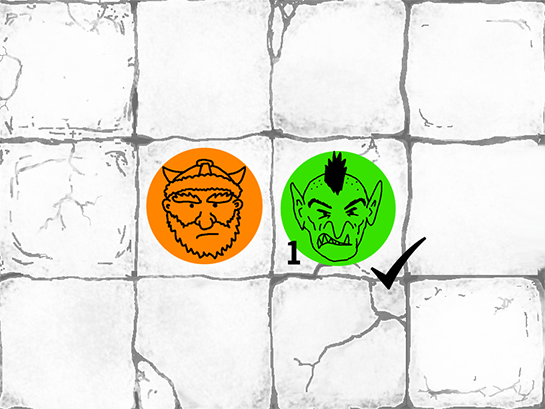
Different weapons have different ranges; in the case of an Unarmed Attack, or an attack with the Dagger, the range is 1. This means that the target of the attack must be in a space directly adjacent to the attacker, or otherwise 1 space away from the space occupied by the attacker.
You may attack through a friendly-occupied space at no penalty, but not through a space occupied by a neutral party or foe, nor through a wall or other physical obstruction.
|
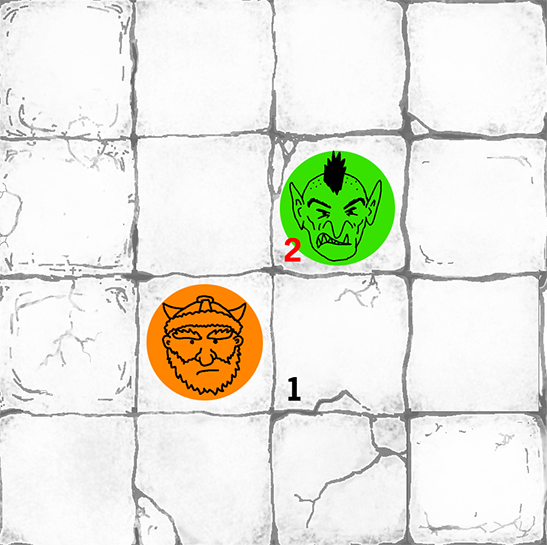
The Dwarf's unarmed attack (Range: 1) is invalid, as his Goblin target is 2 spaces away.
|
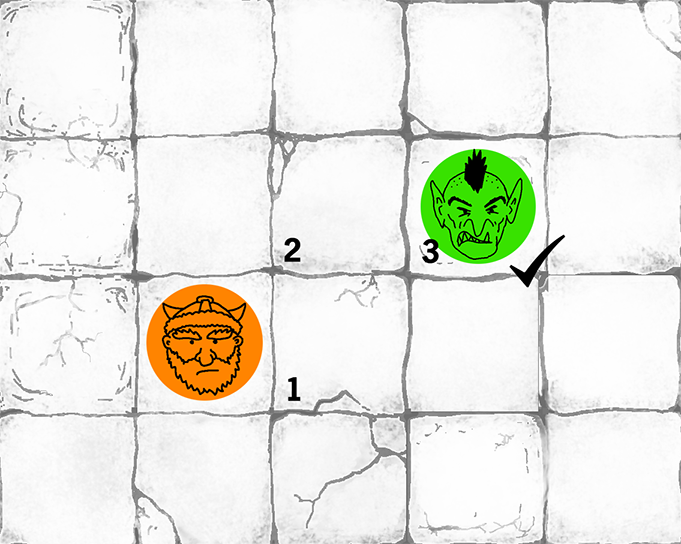
The Dwarf's attack with the Spear (Range: 3) is valid, as his Goblin target is 3 spaces away.
|
3. Roll the appropriate dice based on the attack, and total the results.
For example, an Unarmed Attack is (STR die + STR), so in order to attack Mondo the Goblin, Thurig the Orc rolls his STR die (a d8) and adds his Strength (STR), which is 3. The d8 roll is a 5, so Thurig's total attack roll is 5 + 3, or 8.
4. The target rolls their Defend dice, and totals the results.
By default, a creature's Defend roll is their (DEX die + DEX). In our example with Thurig, his target Mondo has a DEX die of d4 and a Dexterity (DEX) of 2. Mondo's d4 roll is a 1, so his total defense roll is 1 + 2, or 3.
5. If the Defend total is greater than or equal to the Attack total, then the attack concludes without inflicting any damage. Otherwise, deduct that Defend total from the Attack total, then reduce the target's HP by this amount. If a target's HP is reduced to 0 or below, they are immediately Down (see Down under Statuses). If a single wound reduces the target to -10 HP or below, they skip Down entirely and are immediately Unconscious.
In our example with Thurig's attack against Mondo, Thurig's attack total of 8 is reduced by Mondo's defense total of 3. The remaining amount, in this case 5, is deducted from Mondo's Hit Points (HP). Since this attack didn't reduce Mondo's HP to 0 or below, he may continue as normal. Otherwise, Mondo's status would immediately change to Down.
Attack - Unarmed
Roll your STR die and add your STR. Add any other modifiers, and total the result.Attack - Melee Weapon
Check the weapon description to determine the damage dealt. The weapon must be equipped (i.e., currently held in hand) by the attacking character. Add any other modifiers, and total the result.Specialty Attacks
Back Attack: If you attack a creature from the space directly behind them (opposite the direction they are facing), you may optionally re-roll one die in your Attack roll. This can be any one die, including the Critical Hit die, the Ranged Attack Roll d20, or any damage die. You may only re-roll once per Back Attack.Flank Attack: If a character is targeted by more than one attacker (i.e. they are within range of multiple opponents, and one of those opponents has already attacked them since their last turn), then every attacker is allowed to re-roll one die per attack against the flanked target. This can be any one die, including the Critical Hit die, the Ranged Attack Roll d20, or any damage die. You may only do this once per Flank Attack.
Flanked Back Attack: If a character is targeted by more than one attacker (i.e. they are within range of multiple opponents, and one of those opponents has already attacked them since their last turn), AND you can target their back, then you are allowed two re-rolls per attack against the flanked target. These can be any two dice, including the Critical Hit die, the Ranged Attack Roll d20, or any damage die.
Unexpected / Sneak Attack: If a creature is undetected by their target (e.g. after a successful Move Silently / Sneak), the attacker adds an extra +d6 damage to their Attack roll.
This applies to any type of attack (Melee, Ranged, or Magical).
Elevation Advantage: When a character's effective elevation is 30+ units (3+ feet) higher than their opponent, they gain the Upper Hand:
- +1 Ranged Attack (added to hit roll)
- +1 Ranged Damage (added to damage total)
- +1 Melee Attack (added to attack total)
- +1 Melee Defense (added to defense total when the defender is higher)
- +1 Trip/Shove Attack (added to contested attack roll)
Vertical Distance: Elevation difference adds to ranged attack distance for range penalty calculation. 1 vertical space per 50 elevation units (5 feet). Shooting downhill: vertical distance adds to range, but the +1 hit / +1 damage offsets it. Shooting uphill: vertical distance adds to range with no bonus — a pure disadvantage.
Effective elevation includes standable features (e.g., standing on a boulder adds the boulder's height).
Attack - Ranged Weapon
Assuming the weapon is equipped and loaded, fire a ranged weapon (i.e. Shortbow) at a target.
Unlike Melee Attacks, which require only one dice roll, a Ranged Attack is broken into two parts: the Ranged Attack Roll and the Ranged Damage Roll.
Ranged Attack Roll
1. Roll a d20. This is your base Ranged Attack Roll. The target must be at least 3 spaces away — you cannot fire a ranged weapon at a target that is too close.
2. Count the number of spaces between you and the target. For every space beyond the weapon's range, deduct -1 from the Ranged Attack Roll.
3. Untrained archers will deduct -5 from their Ranged Attack Roll. Creatures with the Archery skill will add their Archery bonus to the Ranged Attack Roll (+4 for Archery Basic, +6 for Archery Intermediate, +8 for Archery Advanced, and +10 for Archery Expert).
4. Include any other relevant modifiers (spells, statuses, artifacts, etc.) to the Ranged Attack Roll.
If the calculated total of the Ranged Attack Roll is 10 or greater, your ranged attack has hit, and you can determine the damage inflicted with the Ranged Damage Roll. If the Ranged Attack Roll total is less than 10, the Ranged Attack misses, and the action is concluded. The projectile used (i.e. arrow) is deemed lost.
When using Aim / Focus with a Ranged Attack, roll the Critical Hit die along with the Ranged Damage Roll. A successful Critical Hit will double the Ranged Damage Roll.
Ranged Damage Roll
The Ranged Damage roll varies based on the weapon and projectile used, as well as the attacker's skill. A target struck by a Ranged Attack rolls their Defense as normal, unless otherwise noted.
1. Choose a spell you are able to cast.
2. Spend 3 AP and deduct the spell's MP cost from your current MP. If you do not have enough MP, the spell cannot be cast.
3. Choose a valid target within the spell's range.
4. Resolve the spell's effect as described in the spell's details.
If the spell deals damage, the target rolls their Defense as normal, unless the spell states otherwise.
No Attack or Defense roll is made. The target must be Down — this action cannot be performed on a standing, conscious character.
When a character is attacked, their Defend roll is their DEX die plus their Dexterity, or (DEX die + DEX). Armor, spells, and other modifiers can also add or subtract a character's Defend roll.
When using Defend as an action on one's turn, a character may add a bonus (based on the number of Action Points spent) to their next Defend roll:
1 AP: +1 to next Defense roll.
2 AP: +2 to next Defense roll.
3 AP: +3 to next Defense roll.
All defense bonuses expire at the start of that character's next turn.
Dodger: DEX die + DEX
Occupant: DEX die + DEX
If the dodger's total is greater than the occupant's total, the dodge succeeds and the dodger passes through the space, continuing their movement if they have Move Points remaining. Ties go to the occupant.
If the dodge fails, the dodger remains in their original space and the Move Points are spent.
- Pick Up / Drop — pick up an item from an adjacent space, or drop an inventory item to an adjacent blank space or beneath your character.
- Equip / Swap — wield a weapon, don armor, or move items between hands and containers (belt, travel pack, scabbard, quiver).
- Give / Take — exchange an item with a cardinally adjacent willing ally.
- Load / Reload — move an arrow from quiver to bow, or reload other ammunition.
- Use — activate or use any item: consumables (drink a potion, read a scroll) and reusable tools (strike a flint & steel, use rope, activate an artifact).
One task per Item action; you cannot combine multiple tasks into a single 1 AP spend (except Auto-Equip, below).
Auto-Equip (free): If you are unarmed (no weapon currently wielded) and the item you pick up or receive is a weapon whose requirements you meet, you wield it immediately at no additional AP cost.
Container Free Take: After opening or searching a container with Look / Search, your next Item action to take from that container costs 0 AP, matching the Loot Corpse model. If you act otherwise before taking (move, attack, open another door, etc.) the free take is lost and subsequent takes cost 1 AP each. Ending your turn without taking preserves the free take into your next turn.
If a Hero reaches an exit on a Quest Map, they can remove their figurine from play, and give their turn to any other Hero of their choosing.
Range: Looking at something from a distance gives a description, but opening containers or interacting with features requires adjacency.
Opening containers: When adjacent to a container (treasure chest, etc.), spend 1 AP to view its contents and take up to one item. To take additional items, spend another AP.
Searching for hidden things: If the target cell contains something concealed (a hidden door, a trap, a secret compartment, etc.), a Perception check (your INT die + INT, plus any Perception skill bonuses) is automatically rolled against the difficulty. A successful roll reveals the hidden object or detail.
FREE TAKE ACROSS TURNS: If you browse a corpse without taking anything, your next loot action on that same target is free (0 AP), provided you haven't acted otherwise between the browse and the take. Ending your turn without taking preserves the free take into your next turn. Any other action (move, attack, open a door, etc.) clears it.
Spend 1 AP and roll your DEX die + DEX, plus any relevant modifiers. This is your Move Silently / Sneak roll, which becomes the Difficulty that nearby characters must beat in order to detect you.
Any creature who can "see" you (i.e. has a clear line of sight to your character) will be unaffected by your Move Silently / Sneak. These creatures will continue as normal, aware of your presence.
For creatures who can't see you (e.g. in another room), your movement for the rest of your turn is silent, and you move undetected. Being undetected by a creature grants an additional +d6 to all Steal attempts.
When your character moves undetected, other creatures make a reactive Perception check (their INT die + INT, plus any Perception skill bonuses) at a cost of 0 AP as soon as you enter their line of sight. If their total is greater than or equal to your Move Silently / Sneak roll, they detect you and react accordingly — they may mistrust you, become hostile towards you, target you, and so on.
Any successful Move Silently / Sneak undetected state expires at the end of your turn. When your turn ends, any creature who has a line of sight to yours can "see" you, and is aware of your presence and will act accordingly.
Zaldar may adjust earshot range based on the environment (e.g., a noisy tavern reduces it, a silent cave extends it).
Move Silently may only be attempted once per turn.
Roll: your CHA die + CHA + (Persuasion or Trickery bonus, whichever is higher)
The target rolls their INT die + target's INT + Perception bonus.
The Pacifier must roll strictly higher than the target (ties go to the defender).
On success: The target gains the Pacified status, and on the Pacified creature's next turn, they will not attack the creature who Pacified it. The Pacified status is removed at the end of the Pacified creature's turn.
A creature can be Pacified by multiple characters simultaneously. If the Pacifier attacks the Pacified target, the Pacified status is broken.
Multiple characters may aid the same Down character, and their bonuses combine. The bonus expires after the target's next Recovery Roll, whether or not the roll succeeds.
If a Down character rolls a natural 1 on their Recovery Roll, they become Unconscious. An Unconscious character may attempt a Recovery Roll once every 30 rounds in Quest Mode, or once per hour in Campaign Mode (rather than once per turn). See the Down and Unconscious statuses for full details.
A Down character may, at the start of their turn, spend 1 Dark Star instead of rolling their Recovery Roll. They Recover automatically, exactly as if the Recovery Roll had succeeded: restored to 1 HP, with an immediate full regular turn, and still Tripped.
When a Skill applies, the check is usually called by the Skill's name: a "Perception check" is an INT Stat Check plus any Perception bonus.
Some Stat Checks are reactive and cost 0 AP. These occur in response to another character's action — for example, making a Perception check (your INT die + INT, plus any Perception skill bonuses) to detect a sneaking character, or a CHA-based Stat Check to see through a lie. Zaldar will call for reactive Stat Checks as needed.
• Difficulty Levels
Difficulty 1: Any sentient being can do this for 1 AP. No need to roll.
Difficulty 3 (Trivial): Almost anyone manages this on a first try — a stuck jar lid, a low fence.
Difficulty 6 (Easy): Pretty much anyone can accomplish this their first or second try. Opening an old wooden window.
Difficulty 10 (Moderate): Roughly a 1-in-5 chance for someone of 1 STR / CHA / INT / DEX on their first try; reliable for the capable. A stubborn lid on a jar — a weak person might need many attempts, a strong person 1–3.
Difficulty 14 (Hard): You'd need a strong stat die plus a healthy score (or skill training) to have a reasonable chance — difficult for any untrained individual.
Difficulty 18 (Extreme): Extremely difficult for all except highly-trained specialists, and often only landed with a maxed die and a CRITICAL HIT.
1. The thief rolls a DEX die + DEX, plus any relevant modifiers.
2. The target rolls a DEX die + DEX + INT (their INT is added as a score, not a second die). Ties go to the target.
3. If the thief's total is greater, the Steal succeeds. Zaldar rolls a d12 and cycles through the target's non-equipped inventory to randomly select the stolen item. If the d12 result exceeds the number of items, wrap around to the beginning of the list and keep counting.
Equipped items (weapons in hand, worn armor, etc.) cannot be stolen.
If the target has no non-equipped items in their inventory, the Steal fails automatically — the thief finds nothing. The target does not become aware of the attempt.
Failed Steal: If the target's total is greater than or equal to the thief's total, the Steal fails and the target immediately becomes aware of the attempt.
Beyond Range: A character may attempt to throw an object beyond their throwing range. For each space beyond range, roll the Direction Die once. The object drifts 1 space in the rolled direction for each overshoot. For example, if a character with a throwing range of 7 attempts to throw an object 10 spaces away (3 spaces beyond range), they roll the Direction Die 3 times, and the object drifts 1 space in the rolled direction after each roll.
Damage: A thrown weapon deals d4 damage unless the weapon's description specifically notes it can be thrown, in which case it deals the damage listed there. For other objects (rocks, furniture, etc.), Zaldar determines the damage based on the object's size and weight. The target rolls their Defense as normal.
No-Damage Items: Some items (Cloth, most clothing, etc.) may not inflict damage when thrown, as per Zaldar's discretion.
Thrown Potions and Fragile Items: Potions, flasks, and other fragile items shatter on impact at the space where they land, whether or not the throw was on target.
To perform a Trip / Shove:
1. The attacker rolls the following dice, and adds the results:
Add +3 if the attacker's Size is greater than the target's Size.
2. The target rolls the following, and adds the results:
Add +3 if the target's Size is greater than the attacker's Size.
( Add any relevant Defense modifiers to this roll.
The Aim / Focus action may not be used by either side. )
3. Successful Trip / Shove: If the attacker's total is greater than or equal to the target's total, the maneuver succeeds. The attacker chooses one:
- Trip: The target gains the Tripped status (-2 Attack, -2 Defense, costs 3 MP to Stand Up).
- Shove: The target is pushed 1 space directly away from the attacker.
4. Shoved into a creature: If the target is shoved into a space occupied by another creature, both the shoved target and the occupant are immediately Tripped.
5. Shoved into a wall or obstacle: If the target would be shoved into a wall, the map boundary, or other impassable obstacle, the target does not move but is Tripped in place.
6. Failed Trip / Shove: If the attacker's total is less than the target's total, the target resists, and the action concludes.
Trip / Shove does not trigger the Counterattack skill.
Quest Mode vs. Campaign Mode
Quest Mode is the turn-based portion of the game. It takes place on the Quest Mat, where Heroes and creatures move on a grid and take turns performing Actions. Quest Mode is used for combat encounters, dungeon exploration, and other situations where precise positioning and timing matter.Campaign Mode is a more free-form, conversational style of play. In Campaign Mode, there is no Quest Mat, and Heroes interact with the world through dialogue and narration. Campaign Mode is used for travel, social encounters, shopping, and other situations where strict turn order is unnecessary.
The game naturally transitions between these two modes. For example, Heroes might begin in Campaign Mode as they travel to a dungeon, then switch to Quest Mode when they enter the dungeon and encounter enemies. After the encounter, they might return to Campaign Mode to explore the dungeon's non-combat areas.
Zaldar decides when to transition between modes. When entering Quest Mode, Zaldar sets up the Quest Mat and places characters at their starting positions. When leaving Quest Mode, all game state — HP, MP, inventory, statuses, and so on — carries over into Campaign Mode.
Resting, Health, and Food
Heroes need to eat, drink, and rest to stay in fighting condition.Food and Water: A Hero should consume at least 1 Food and 1 Water (or equivalent) per day. Going without food progresses through the following statuses: after 1 day without food, a Hero becomes Hungry; after 2 days, Starving. Going without water follows a similar progression: after 1 day, Thirsty; after 2 days, Dehydrated. Consuming the appropriate supplies reduces the status by one step: Starving → Hungry → cured, and Dehydrated → Thirsty → cured. Two consumptions are required to fully cure a severe status.
These statuses carry mechanical penalties: Hungry removes STR from rolls; Starving also treats the STR die as 1. Thirsty removes DEX from rolls; Dehydrated also removes CHA and INT, and prevents Running and Jumping. See the individual status entries for full details.
Resting: A Hero who rests for at least 8 hours (typically overnight) recovers all HP and MP to their maximum values. If the Hero is Hungry, Thirsty, or suffering from a similar status, they still rest but do not recover HP or MP until the status is resolved.
Travel
Travel between locations occurs during Campaign Mode. Zaldar narrates the journey and may introduce encounters, obstacles, or points of interest along the way. The Quest Book or Zaldar's notes will indicate travel durations between key locations.During travel, Heroes consume food and water as normal (1 of each per day). Zaldar may call for random encounters or events during the journey, temporarily switching to Quest Mode if combat occurs.
Acquiring Gold
Heroes acquire gold through quest rewards, looting defeated enemies and containers, selling unwanted items, and other means at Zaldar's discretion. Starting gold for new Heroes is determined by Zaldar based on the campaign — a common starting amount is 50-100 gold for a Level 1 Hero.Buying and Selling
In towns and settlements, Heroes may purchase goods from merchants. Items are listed with a Cost in gold. To buy an item, the Hero must have enough gold and the item must be available.Rarity is a number from 1 to 10 that indicates how difficult an item is to find. Low-rarity items (1-3) are common and typically available at most merchants. Mid-rarity items (4-6) may require visiting a specialized shop or a larger settlement. High-rarity items (7-10) are extremely scarce and may not be available for purchase at all — Zaldar determines whether a merchant has a rare item in stock based on the location and circumstances.
- 1 — The dirt beneath your feet
- 2 — Extremely common: loose stones, sticks, broken pottery, scraps of cloth
- 3 — Common: rope, bottle, simple weapons, basic clothing, basic foods
- 4 — Uncommon: quality equipment, trade goods, crafted items made by skilled hands
- 5 — Rare: valuables, finely crafted weapons, designer garments
- 6 — Very rare: a collector's prize, found only in the largest cities or guarded vaults
- 7 — Extremely rare: most people have only heard rumors of such things
- 8 — Legendary: known by name in songs and stories, seen by very few living souls
- 9 — Almost mythical: scholars debate whether it ever truly existed; perhaps one remains in the world
- 10 — Generally regarded by most as a myth, only a small few believe it actually exists
Heroes may also sell items they no longer need. By default, merchants will buy items at half their listed cost, rounded down. Heroes with the Trickery skill (Intermediate or higher) receive bonus gold when selling items — see the Trickery skill entry for details.
Leveling Up
Every Hero starts at Level 1. During Campaign Mode, a Hero may gain a level by spending 3 Character Points on improvements.Character Points are accumulated by completing Quests and other accomplishments throughout the campaign. In a typical campaign, a single Quest might reward 1-2 Character Points just for completing it.
To advance a level, spend your accumulated Character Points on any of the following improvements. Each Character Point spent may be used for one of:
• Increase a Stat Score (STR, DEX, INT, or CHA) by 1
• Increase HP by 3
• Increase MP by 2
The following improvements cost more than 1 Character Point:
• Acquiring a Skill (the number of Character Points required varies based on the Skill). When a Skill has multiple tiers (e.g. Basic, Intermediate, Advanced), purchasing a higher tier replaces the previous one — a Hero only ever has one tier of a given Skill at a time.
• 2 Character Points: Reduce your Recovery by 1. The minimum Recovery for a Hero is 5.
• 2 Character Points: Upgrade one Stat Die (STR, DEX, CHA, or INT) by one step along the die ladder: d4 → d6 → d8 → d10 → d12. This raises the ceiling and feel of that stat's rolls, distinct from increasing the flat Stat Score. Because a level grants only 3 Character Points, a Stat Die may advance at most one step per level.
• 3 Character Points: Increase your MOVE by 1. The maximum base MOVE for any Hero is 10. Artifacts, spells, and other effects may increase effective MOVE beyond this limit.
Any one type of improvement may only be taken twice per level gain. Each Stat (STR, DEX, INT, CHA), HP, MP, Recovery, MOVE, and each individual Skill counts as a separate type.
For example, when advancing a level, a Hero may spend 2 Character Points to increase their CHA score by 2, but may not spend the third Character Point to increase their CHA again. They must instead spend it on a different improvement, such as increasing their HP by 3, learning the First Aid (Basic) skill, increasing their DEX by 1, and so on.
Dying
DownWhen a Hero's HP is reduced to 0 or below, they become Down. A Down Hero collapses but is not yet out of the fight. If a single wound reduces a Hero to -10 HP or below, they skip Down entirely and become immediately Unconscious.
Recovery from Down
At the start of each of their turns, a Down Hero attempts a Recovery Roll (d20 vs their Recovery value). On a success, the Hero regains consciousness at 1 HP and may act on their turn. On a failure, the Hero remains Down. On a natural 1, the Hero becomes Unconscious.
A Down Hero can also be restored by a healing spell or First Aid from an adjacent ally — this immediately restores them from Down with HP equal to the healing amount. Alternatively, an adjacent enemy may perform a Coup de Grace (1 AP) to render the Down Hero Unconscious.
Unconscious
An Unconscious Hero is completely incapacitated. They cannot act, and their space is treated as empty for movement purposes. An Unconscious Hero attempts a Recovery Roll once every 30 rounds (Quest Mode) or once per hour (Campaign Mode). On a success, they regain consciousness at 1 HP. On a natural 1, the Hero dies.
Death
When a Hero dies, their belongings remain on the Quest Mat where they fell and may be looted by other characters. Whether the player creates a new Hero or the story provides a means of resurrection is at Zaldar's discretion and depends on the campaign.
Skills
+4 to Ranged Attack Roll
+6 to Ranged Attack Roll
Bullseye: If the Ranged Attack Roll yields a 20 on the d20, the Ranged Damage Roll total is doubled. This doubling is factored into any other modifiers (Critical Hit, spells / artifacts, etc.) that affect the Ranged Damage Roll.
+8 to Ranged Attack Roll
Bullseye: If the Ranged Attack Roll yields a 19 or 20 on the d20, the Ranged Damage Roll total is doubled. This doubling is factored into any other modifiers (Critical Hit, spells / artifacts, etc.) that affect the Ranged Damage Roll.
+10 to Ranged Attack Roll
Bullseye: If the Ranged Attack Roll yields an 18, 19, or 20 on the d20, the Ranged Damage Roll total is doubled. This doubling is factored into any other modifiers (Critical Hit, spells / artifacts, etc.) that affect the Ranged Damage Roll.
If a creature attacks your character in melee and the attack deals 5 or more HP in damage (after your Defend roll), your character is not rendered Down by this attack, and the creature that attacked you is within range of your current melee weapon, you may immediately make a free melee attack against that creature at the cost of 0 Action Points.
You may not use the Aim / Focus action to roll the Critical Hit die with this attack. The attacked creature defends as normal.
If a creature attacks your character in melee and the attack deals 1 or more HP in damage (after your Defend roll), your character is not rendered Down by this attack, and the creature that attacked you is within range of your current melee weapon, you may immediately make a free melee attack against that creature at the cost of 0 Action Points.
You may not use the Aim / Focus action to roll the Critical Hit die with this attack. The attacked creature defends as normal.
If a creature attacks your character in melee, regardless of whether the attack deals damage or renders your character Down, and the creature that attacked you is within range of your current melee weapon, you may immediately make a free melee attack against that creature at the cost of 0 Action Points.
You may not use the Aim / Focus action to roll the Critical Hit die with this attack. The attacked creature defends as normal.
It can be used on a Down character, raising their HP above 0, and removing their Down status. A character who is Down cannot use First Aid on themselves (it requires 3 AP). First Aid cannot be used on an Unconscious character.
If you or an adjacent creature has taken damage, and you have 1x Cloth and 1x Bottle of Water in your possession, you may spend 3 Action Points to restore some HP to the creature of your choice. The Cloth is considered used and discarded, however the empty Bottle may be reused.
Restore 1d6 HP.
Restore 1d12 HP.
Restore 1d20 HP.
Any character with an INT score of 2 or more can do a Perception check. By default, a Perception check is just an INT check: roll your INT die and add your INT score.
Zaldar may call for Perception checks reactively (0 AP) when another character attempts Pacify, Move Silently, or similar actions against a Hero. Zaldar may also roll Perception checks in private, to see if a character became wise to some concealed detail.
A Hero on their turn may spend 1 AP to make a Perception check, when using the Look / Search action to find hidden things.
Gain a +3 on all Perception checks.
Gain a +6 on all Perception checks.
Gain a +9 on all Perception checks.
Any character may attempt Persuasion untrained at no bonus — by default a Persuasion roll is just a CHA Stat Check, so roll the character's CHA die and add their CHA. Purchasing a Persuasion tier adds a flat bonus on top; "untrained" simply means the skill was not purchased.
Conversations between Heroes and NPCs don't always require dice rolls. However, a Hero may declare they're attempting to use Persuasion when they want to achieve a specific outcome in a conversation; conversely, Zaldar may ask a Hero to roll a Persuasion roll following something they've said.
Sometimes, NPCs will have fixed target Difficulties in the Quest Book, i.e., a shy elf will agree it's in her interests to lead the Heroes to the blessed spring on a Difficulty 14+ Persuasion roll. In other situations, where a target Difficulty is not noted, Zaldar can set a target Difficulty on the fly based on the circumstances, adding penalties or bonuses to the impromptu target Difficulty as they see fit.
Zaldar can also have the recipients of Persuasion attempts roll Perception checks. If the Perception check is greater than the Persuasion roll, it can be concluded the attempt was unsuccessful and the audience was unreceptive.
As always, Zaldar should reward players for clever, creative, or provocative roleplaying; however, Zaldar's rulings are final, and while the Heroes have agency to manipulate the world, they should not be allowed to achieve things beyond reason just because the dice rolls were good.
Inspire: Persuasion (Intermediate) allows a player to use Inspire — spend 1 MP to give an ally within line of sight (up to 10 spaces) a bonus on their next Recovery or Defend roll. Inspire is reactive, used outside the inspirer's own turn, and can be used only once between the inspirer's own turns; it resets at the start of that character's next turn. Inspire can override a natural 1 on a Recovery roll — if the bonus raises the result above 1, it is treated as a normal low roll rather than an automatic Unconscious trigger. A character cannot Inspire themselves, and the inspirer must be alive, conscious, and not Stunned.
Gain a +3 on all Persuasion rolls.
Gain a +6 on all Persuasion rolls. Persuasion (Intermediate) allows a player to use Inspire: +d4 to an ally's roll.
Gain a +9 on all Persuasion rolls. Inspire's bonus improves to +(your CHA die).
Requirements: 3 DEX
A creature with the Quick Draw skill may perform one Item action per turn at a cost of 0 Action Points. Additional Item actions that turn cost the standard 1 AP each.
You may choose a Primary Magic School, and cast all Apprentice spells in that school.
You may cast all Spellcaster and Apprentice spells in your Primary Magic School.
You may cast all Sorcerer, Spellcaster, and Apprentice spells in your Primary Magic School. You may also choose a Secondary Magic School, and you may cast all Apprentice spells in that school.
You may cast all Power Mage, Sorcerer, Spellcaster, and Apprentice spells in your Primary Magic School. You may also cast all Spellcaster and Apprentice spells in your Secondary Magic School.
You may cast all spells in your Primary Magic School. You may also cast Sorcerer and Spellcaster spells in your Secondary Magic School. You may cast any Apprentice spell in any Magic School.
Any character may attempt Trickery untrained at no bonus — by default a Trickery roll is just a CHA Stat Check, so roll the character's CHA die and add their CHA. Purchasing a Trickery tier adds a flat bonus on top; "untrained" simply means the skill was not purchased.
Conversations between Heroes and NPCs don't always require dice rolls. However, a Hero may declare they're attempting Trickery when they want to deceive someone in a conversation; conversely, Zaldar may ask a Hero to roll a Trickery roll following something they've said.
Sometimes, NPCs will have fixed target Difficulties in the Quest Book, i.e., a goblin will be convinced that the Heroes are actually high-ranking members of the goblin's gang and thus welcome in their gang's hideout on any successful Difficulty 14+ Trickery roll. In other situations, where a target Difficulty is not noted, Zaldar can set a target Difficulty on the fly based on the circumstances, adding penalties or bonuses to the impromptu target Difficulty as they see fit.
Zaldar can also have the recipients of Trickery attempts roll Perception checks. If the Perception check is greater than the Trickery roll, it can be concluded the deception was unsuccessful and the intended fools were not convinced by the Hero's tale.
As always, Zaldar should reward players for clever, creative, or provocative roleplaying; however, Zaldar's rulings are final, and while the Heroes have agency to manipulate the world, they should not be allowed to achieve things beyond reason just because the dice rolls were good.
Gain a +3 on all Trickery rolls. Receive an additional 1d6 Gold when selling at least 30 Gold worth of items.
Gain a +6 on all Trickery rolls. Receive an additional 2d6 Gold when selling at least 20 Gold worth of items.
Gain a +9 on all Trickery rolls. Receive an additional (3d6 + CHA) Gold when selling at least 10 Gold worth of items.
Statuses
On a 1, the Confused creature takes their turn as normal.
On a 2, the Confused creature cannot Move, but can still perform Actions.
On a 3, the Confused creature can perform no Actions, but can still Move.
On a 4, the Confused creature can neither Move nor perform Actions on their turn, effectively skipping their turn; however, rolling a 4 and skipping a turn also resolves and removes the Confused status from the creature.
If a 4 is not rolled, a Confused creature has two choices to resolve their state:
1. Spend 1 Action Point, and pass a Difficulty 10+ INT roll.
2. Spend 2 Action Points and 1 Mind Point
A Confused creature that performs either of these on their turn has their Confused status removed. Confusion can also be resolved by artifacts, spells, or other interactions, as per Zaldar's discretion.
Cure: Drink water or another hydrating liquid. The Dehydrated status is removed and replaced with Thirsty. A second drink removes Thirsty.
Quest Mode: HP is cut in half at the end of every turn. Round remaining HP up if not a whole number. If a Diseased character has 1 HP at the end of their turn, they are immediately set to Down. A Diseased creature at 0 HP or below takes 3 HP damage each turn until they are Unconscious. An Unconscious creature does not take Diseased damage.
Campaign Mode: HP is not halved per turn. Instead, the Diseased character has 3 days to find a cure. If the disease is not cured within 3 days, the character dies and becomes a Zombie under Zaldar's control.
Cure: Drink a Cure Disease potion, or receive a healing spell or remedy at Zaldar's discretion.
A Down character's HP is set to 0. Place the figurine flat on its back to indicate they are Down. A Down character is also considered Tripped.
A Down character is limited to 1 Move Point and 1 Action Point per turn. While Down, a character may only perform the following actions: Item, Throw, Look / Search, and Recovery (0 AP). All other actions — including Attack, Cast Spell, Defend, Dodge, Trip / Shove, Move Silently, and Steal — cannot be performed while Down. A Down character cannot defend when attacked — attacks against a Down character auto-hit for full damage.
A Down character who takes damage while at 0 HP tracks negative HP. If their HP reaches -10 or below, they become Unconscious.
Recovery
At the start of a Down character's turn, at a cost of 0 Action Points, the player controlling the Down character rolls a d20 for that character's Recovery roll.
If the result of the Recovery roll meets or exceeds that character's Recovery, the character is considered recovered. Their HP is set to 1, and they may immediately take a full turn with their normal 3 Action Points and full Move Points. The character remains Tripped until they spend 3 Move Points to Stand Up.
If the Down character rolls a 1 on their Recovery roll, that character immediately becomes Unconscious.
Certain spells, artifacts, and other conditions may affect a character's Recovery roll.
Cure: Eat a meal or food ration. The Hungry status is removed immediately.
The Magic status is removed when the spell's duration expires, when the caster loses consciousness, or when dispelled by another spell or artifact, as per Zaldar's discretion.
Extinguish (Self): Spend 3 AP and 3 Move Points to roll on the ground. Succeed at a Difficulty 6+ DEX check to extinguish the flames.
Extinguish (Ally): An adjacent ally may spend 2 AP to attempt to smother or beat out the flames. Succeed at a Difficulty 8+ DEX check to extinguish.
Water: Submerging in water immediately extinguishes all flames.
FIRE Tiles: A fire space contains a stack of 1x1 FIRE tiles equal to its current strength. A strength-4 fire is represented by 4 FIRE tiles stacked on the same space. FIRE tiles are hazard overlays, not occupied spaces; figures can stand on, move through, or be forced onto fire spaces. At the start of Zaldar's phase, remove 1 FIRE tile from each fire stack (this occurs regardless of whether Zaldar has active creatures). When the last FIRE tile is removed, the fire goes out.
Passing through fire: A creature passing through a space with FIRE tiles must succeed at a Difficulty 6+ DEX check or become On Fire.
Ending movement on fire: A creature that ends its movement on a space with FIRE tiles automatically becomes On Fire — no check.
A creature can be Pacified by multiple characters simultaneously, and will avoid attacking all of them.
If the Pacifier attacks the Pacified creature, the Pacified status from that character is broken immediately.
All Pacified statuses are cleared at the end of the Pacified creature's turn.
Cure: Drink water or another hydrating liquid. The Thirsty status is removed immediately.
A Tripped creature may Crawl while prone at a cost of 2 Move Points per space (instead of the normal 1). A Tripped creature may not Run.
A Tripped creature may spend 3 Move Points to Stand Up, removing the Tripped status and all penalties. A creature may not Run on the same turn it stands up.
A character may voluntarily drop to the ground as a free action on their turn, becoming Tripped. This can be useful for fitting under obstacles or taking cover behind low terrain.
A Tripped creature retains their full Action Points. While Tripped, a creature cannot: Walk, Run, Dodge, Jump, Steal, Climb, or Swim. The only movement available is Crawl (2 MP per cardinal space) and Stand Up (3 MP).
Place the figurine flat on its back to indicate it is Tripped.
All creatures may pass through a space occupied by a Tripped creature at no penalty, however, their movement may not end on a space occupied by a Tripped creature.
Cure: A specific spell, artifact, or other remedy as determined by Zaldar. The Turned To Stone status cannot be removed by ordinary means.
In Quest Mode, Unconscious characters roll a Recovery roll once every 30 rounds, starting from the round they first become Unconscious. In Campaign Mode, the Recovery roll occurs once per hour.
Passing the roll restores the character to 1 HP and 0 MP. Rolling a 1 during a Recovery roll while Unconscious results in the immediate death of the character.
An Unconscious creature does not prevent movement through or onto the space where it lies — it is treated as a normal valid space.
Creatures
| HP | MP | Move | Size | Recovery |
|---|---|---|---|---|
| 18 | 6 | 5 | 80 | 14+ |
| STR | DEX | CHA | INT |
|---|---|---|---|
| d8 + 4 | d8 + 2 | d4 + 0 | d6 + 2 |
Fire Absorption
A Demon is immune to the On Fire status. Any Fire-school spell damage directed at a Demon heals the Demon instead. Fire damage from non-spell sources (exploding skulls, thrown torches) is absorbed and heals for half the damage value.Water Vulnerability
Water-school spell damage is doubled against a Demon. Holy Water items deal d10 damage (no Defense roll).Level Progression
| LVL | Name | HP | MP | STR | DEX | CHA | INT |
|---|---|---|---|---|---|---|---|
| 1 | — | 18 | 6 | 4 | 2 | 0 | 2 |
| 2 | Imp | 18 | 8 | 5 | 2 | 0 | 2 |
| 3 | — | 21 | 10 | 6 | 3 | 0 | 3 |
| 4 | Demon | 24 | 12 | 7 | 3 | 0 | 3 |
| 5 | — | 24 | 14 | 8 | 4 | 0 | 4 |
| 6 | Greater Demon | 27 | 16 | 9 | 4 | 0 | 4 |
| 7 | — | 30 | 18 | 10 | 5 | 0 | 5 |
| 8 | Fiend | 30 | 20 | 11 | 5 | 0 | 5 |
| 9 | — | 33 | 22 | 12 | 6 | 0 | 6 |
| 10 | Arch-Demon | 36 | 24 | 13 | 6 | 0 | 6 |
| 11 | Demon Lord | 39 | 26 | 14 | 7 | 0 | 7 |
Fixed across all levels: Move 5, Recovery 14+, STR die d8, DEX die d8, Size 80. CHA cannot exceed 0.
| HP | MP | Move | Size | Recovery |
|---|---|---|---|---|
| 12 | 0 | 7 | 60 | 16+ |
| STR | DEX | CHA | INT |
|---|---|---|---|
| d6 + 3 | d10 + 2 | — + 0 | — + 1 |
Flight
A Gargoyle can fly. While flying, it ignores ground-level obstacles (boulders, furniture, pits) but not walls or closed doors. Flying movement costs are normal. A flying Gargoyle cannot be targeted by melee attacks from non-flying creatures unless they have a weapon with Range 2+.Stone Form (Ambush)
A Gargoyle placed with disposition "inactive" begins in Stone Form — indistinguishable from a stone statue decoration. While in Stone Form, the Gargoyle has +5 to Defense (effectively invulnerable to casual damage) and cannot act. Stone Form ends when a hero enters the Gargoyle's activation trigger range, at which point the Gargoyle immediately becomes active and takes its first turn with full AP. The surprise factor means heroes do not get a free reaction.Immunities
Immune to Poison and Disease.Restrictions
CHA cannot exceed 0. INT cannot exceed 1.Level Progression
| LVL | Name | HP | MP | STR | DEX | CHA | INT |
|---|---|---|---|---|---|---|---|
| 1 | — | 12 | 0 | 3 | 2 | 0 | 1 |
| 2 | Stone Imp | 12 | 0 | 4 | 2 | 0 | 1 |
| 3 | — | 15 | 0 | 5 | 3 | 0 | 1 |
| 4 | Gargoyle | 15 | 0 | 6 | 3 | 0 | 1 |
| 5 | — | 18 | 0 | 7 | 4 | 0 | 1 |
| 6 | Greater Gargoyle | 18 | 0 | 8 | 5 | 0 | 1 |
| 7 | — | 21 | 0 | 9 | 5 | 0 | 1 |
| 8 | Stone Sentinel | 21 | 0 | 10 | 6 | 0 | 1 |
| 9 | — | 24 | 0 | 11 | 7 | 0 | 1 |
| 10 | — | 24 | 0 | 12 | 7 | 0 | 1 |
| 11 | Gargoyle Lord | 27 | 0 | 13 | 8 | 0 | 1 |
Fixed across all levels: Move 7, Recovery 16+, STR die d6, DEX die d10, Size 60. CHA cannot exceed 0. INT cannot exceed 1. MP is always 0.
| HP | MP | Move | Size | Recovery |
|---|---|---|---|---|
| 17 | 10 | 3 | 100 | 15+ |
| STR | DEX | CHA | INT |
|---|---|---|---|
| d4 + 3 | d8 + 2 | — - 2 | — + 1 |
Snake Bites
Instead of a normal melee attack, a Medusa's serpent-hair delivers a chain of rapid bites. Roll d4 three times in succession. Each roll that exceeds the target's individual Defense roll (DEX die + DEX + armor) deals its damage. This counts as a single 2 AP attack action.Turn to Stone (Level 4+)
Cost: 3 AP, 5 MPThe Medusa locks eyes with an adjacent target that has line of sight to her. The target must make a contested d12+INT check against the Medusa's d12+INT. On failure, the target is Stunned for 2 rounds (representing partial petrification). On a natural 1, the target is fully petrified and Turned to Stone.
Restrictions
Cannot Run. CHA cannot exceed -2.Level Progression
| LVL | Name | HP | MP | STR | DEX | CHA | INT |
|---|---|---|---|---|---|---|---|
| 1 | — | 17 | 10 | 3 | 2 | -2 | 1 |
| 2 | Young Medusa | 17 | 12 | 4 | 2 | -2 | 2 |
| 3 | — | 20 | 14 | 5 | 3 | -2 | 2 |
| 4 | Medusa | 20 | 16 | 6 | 3 | -2 | 3 |
| 5 | — | 23 | 18 | 7 | 4 | -2 | 3 |
| 6 | Greater Medusa | 26 | 20 | 8 | 4 | -2 | 4 |
| 7 | — | 26 | 22 | 9 | 5 | -2 | 4 |
| 8 | Gorgon | 29 | 24 | 10 | 5 | -2 | 5 |
| 9 | — | 32 | 26 | 11 | 6 | -2 | 5 |
| 10 | — | 32 | 28 | 12 | 6 | -2 | 6 |
| 11 | Gorgon Queen | 35 | 30 | 13 | 7 | -2 | 7 |
Fixed across all levels: Move 3, Recovery 15+, STR die d4, DEX die d8, Size 100. CHA cannot exceed -2.
| HP | MP | Move | Size | Recovery |
|---|---|---|---|---|
| 20 | 0 | 3 | 60 | 12+ |
| STR | DEX | CHA | INT |
|---|---|---|---|
| d8 + 4 | d6 + 0 | — + 0 | — + 0 |
Mummy's Curse
Any creature that hits a Mummy with a melee attack risks contracting the Mummy's Curse. After resolving the attack, roll d6: on a 1, the attacker immediately acquires the Diseased status. The curse is transmitted through contact with the Mummy's ancient wrappings.Fire Vulnerability
Fire-school spell damage is doubled against a Mummy. If a Mummy is set On Fire, the fire cannot be extinguished — the ancient linen wrappings burn permanently. The Mummy remains On Fire until destroyed.Shambling Movement
A Mummy uses the same shambling movement rules as a Zombie. After its normal movement, it may roll the Direction Die and must then move in the rolled direction.Immunities
Immune to Poison and Disease.Restrictions
Cannot Run. DEX, CHA, and INT cannot exceed 0.Level Progression
| LVL | Name | HP | MP | STR | DEX | CHA | INT |
|---|---|---|---|---|---|---|---|
| 1 | — | 20 | 0 | 4 | 0 | 0 | 0 |
| 2 | Shambling Husk | 23 | 0 | 5 | 0 | 0 | 0 |
| 3 | — | 26 | 0 | 6 | 0 | 0 | 0 |
| 4 | Mummy | 29 | 0 | 7 | 0 | 0 | 0 |
| 5 | — | 32 | 0 | 8 | 0 | 0 | 0 |
| 6 | Embalmed Guardian | 35 | 0 | 9 | 0 | 0 | 0 |
| 7 | — | 38 | 0 | 10 | 0 | 0 | 0 |
| 8 | — | 38 | 0 | 11 | 0 | 0 | 0 |
| 9 | Mummy Lord | 41 | 0 | 12 | 0 | 0 | 0 |
| 10 | — | 44 | 0 | 13 | 0 | 0 | 0 |
| 11 | Pharaoh's Wrath | 47 | 0 | 14 | 0 | 0 | 0 |
Fixed across all levels: Move 3, Recovery 12+, STR die d8, DEX die d6, Size 60. DEX, CHA, and INT cannot exceed 0. MP is always 0.
| HP | MP | Move | Size | Recovery |
|---|---|---|---|---|
| 15 | 0 | 3 | 120 | 17+ |
| STR | DEX | CHA | INT |
|---|---|---|---|
| d12 + 5 | d10 + 1 | — + 0 | — + 1 |
Large Creature (2x2)
An Ogre occupies a 2x2 space on the Quest Mat. Movement costs 1 Move per space; the entire 2x2 block shifts together. An Ogre cannot fit through 1-wide corridors or standard doorways (use Doorway Destruction or a wider opening). Cardinal adjacency to any of the 4 occupied spaces counts as adjacent. An Ogre can attack anything adjacent to its block, and anything adjacent to its block can attack it.Restrictions
Cannot Run. INT cannot exceed 1. CHA cannot exceed 0.Level Progression
| LVL | Name | HP | MP | STR | DEX | CHA | INT |
|---|---|---|---|---|---|---|---|
| 1 | — | 15 | 0 | 5 | 1 | 0 | 1 |
| 2 | Minor Ogre | 15 | 0 | 6 | 1 | 0 | 1 |
| 3 | — | 18 | 0 | 8 | 1 | 0 | 1 |
| 4 | Ogre | 18 | 0 | 10 | 2 | 0 | 1 |
| 5 | — | 21 | 0 | 12 | 2 | 0 | 1 |
| 6 | Ogre Brute | 24 | 0 | 13 | 3 | 0 | 1 |
| 7 | — | 27 | 0 | 15 | 3 | 0 | 1 |
| 8 | — | 27 | 0 | 17 | 4 | 0 | 1 |
| 9 | Greater Ogre | 30 | 0 | 19 | 4 | 0 | 1 |
| 10 | — | 33 | 0 | 20 | 5 | 0 | 1 |
| 11 | Juggernaut | 36 | 0 | 22 | 5 | 0 | 1 |
Fixed across all levels: Move 3, Recovery 17+, STR die d12, DEX die d10, Size 120.
Floor Smash (Level 6+)
Cost: 3 APThe Ogre smashes the ground with tremendous force. All creatures Size 60 and below within 10 spaces become Tripped.
Doorway Destruction (Level 9+)
Cost: 3 APThe Ogre can punch through a 1x1 doorway, replacing it with a 2x2 rubble tile.
| HP | MP | Move | Size | Recovery |
|---|---|---|---|---|
| 1 | 0 | 10 | 10 | N/A |
| STR | DEX | CHA | INT |
|---|---|---|---|
| d4 + 0 | d4 + 1 | — + 0 | — + 1 |
Restrictions
Cannot Run.Level Progression
| LVL | Name | HP | MP | STR | DEX | CHA | INT |
|---|---|---|---|---|---|---|---|
| 1 | Nestling | 1 | 0 | 0 | 0 | 0 | 1 |
| 2 | Lost Pet | 1 | 0 | 0 | 1 | 0 | 1 |
| 3 | Sewer Rat | 2 | 0 | 0 | 2 | 0 | 1 |
| 4 | — | 2 | 0 | 0 | 3 | 0 | 1 |
| 5 | — | 3 | 0 | 0 | 4 | 0 | 1 |
| 6 | Giant Rat | 3 | 0 | 1 | 5 | 0 | 1 |
| 7 | — | 4 | 0 | 1 | 6 | 0 | 1 |
| 8 | — | 4 | 0 | 2 | 7 | 0 | 1 |
| 9 | Dire Rat | 5 | 0 | 3 | 8 | 0 | 1 |
| 10 | — | 5 | 0 | 8 | 9 | 0 | 1 |
| 11 | Rat King | 6 | 0 | 13 | 10 | 0 | 2 |
Fixed across all levels: Move 10, Recovery N/A, STR die d4, DEX die d4, Size 10. MP is always 0.
| HP | MP | Move | Size | Recovery |
|---|---|---|---|---|
| 2 | 0 | 6 | 60 | N/A |
| STR | DEX | CHA | INT |
|---|---|---|---|
| d6 + 1 | d4 + 0 | — + 0 | — + 0 |
Immunities
Immune to Poison and Disease.Level Progression
| LVL | Name | HP | MP | STR | DEX | CHA | INT |
|---|---|---|---|---|---|---|---|
| 1 | — | 2 | 0 | 1 | 0 | 0 | 0 |
| 2 | Animated Bones | 6 | 0 | 2 | 1 | 0 | 0 |
| 3 | — | 9 | 0 | 3 | 2 | 0 | 0 |
| 4 | Skeleton | 12 | 0 | 4 | 3 | 0 | 0 |
| 5 | — | 12 | 0 | 6 | 4 | 0 | 0 |
| 6 | Skeleton Warrior | 15 | 0 | 7 | 5 | 0 | 0 |
| 7 | — | 15 | 0 | 8 | 7 | 0 | 0 |
| 8 | Bone Sentry | 18 | 0 | 9 | 8 | 0 | 0 |
| 9 | Dread Skull | 18 | 0 | 11 | 9 | 0 | 0 |
| 10 | — | 21 | 0 | 12 | 10 | 0 | 0 |
| 11 | Skeleton Overlord | 24 | 0 | 13 | 11 | 0 | 0 |
Fixed across all levels: Move 6, Recovery N/A, STR die d6, DEX die d4, Size 60. INT and CHA cannot exceed 0. MP is always 0.
Throw Exploding Skull (Level 6+)
Cost: 1 AP, 1 HPThe Skeleton ignites and throws its own skull as an incendiary projectile. The skull follows the rules for Throw. Any creature hit takes fire damage and may catch On Fire. The Skeleton loses 1 HP (its own skull). A headless Skeleton can still fight but cannot use this ability again unless it harvests a new skull.
Harvest Skull (Level 8+)
Cost: 3 APThe Skeleton harvests a skull from an adjacent corpse. The harvested skull can be ignited and thrown using Throw Exploding Skull.
| HP | MP | Move | Size | Recovery |
|---|---|---|---|---|
| 20 | 8 | 3 | 100 | 12+ |
| STR | DEX | CHA | INT |
|---|---|---|---|
| d8 + 4 | d6 + 0 | d4 + 0 | d6 + 3 |
Regeneration
At the start of each of its turns, a Troll regenerates 2 HP (up to its maximum). This regeneration is suppressed for one full round if the Troll took fire damage since its last turn. A Troll at 0 HP that regenerates back to 1+ HP stands up automatically (it was merely stunned, not truly defeated).Gemstone Staff
Each Troll wields a Gemstone Staff attuned to a random school of sorcery (Fire, Air, Water, Emara, Heart, or Chaos — determined by Zaldar when the Troll is placed). The staff allows the Troll to cast one spell per turn from that school at Apprentice tier, using its INT and MP pool. The Troll's weakness is the opposing school: Fire↔Water, Air↔Emara, Heart↔Chaos. Spells from the opposing school deal double damage to the Troll.Restrictions
Cannot Run. DEX and CHA cannot exceed 0.Level Progression
| LVL | Name | HP | MP | STR | DEX | CHA | INT |
|---|---|---|---|---|---|---|---|
| 1 | — | 20 | 8 | 4 | 0 | 0 | 3 |
| 2 | Young Troll | 23 | 10 | 5 | 0 | 0 | 3 |
| 3 | — | 26 | 12 | 6 | 0 | 0 | 4 |
| 4 | Troll | 29 | 14 | 7 | 0 | 0 | 4 |
| 5 | — | 32 | 16 | 8 | 0 | 0 | 5 |
| 6 | Troll Shaman | 35 | 18 | 9 | 0 | 0 | 5 |
| 7 | — | 38 | 20 | 10 | 0 | 0 | 6 |
| 8 | — | 38 | 22 | 11 | 0 | 0 | 6 |
| 9 | Elder Troll | 41 | 24 | 12 | 0 | 0 | 7 |
| 10 | — | 44 | 26 | 13 | 0 | 0 | 7 |
| 11 | Troll King | 47 | 28 | 14 | 0 | 0 | 8 |
Fixed across all levels: Move 3, Recovery 12+, STR die d8, DEX die d6, Size 100. DEX and CHA cannot exceed 0.
| HP | MP | Move | Size | Recovery |
|---|---|---|---|---|
| 14 | 5 | 7 | 60 | N/A |
| STR | DEX | CHA | INT |
|---|---|---|---|
| d6 + 3 | d8 + 3 | d8 + 3 | d8 + 3 |
Life Drain
Whenever a Vampire deals melee damage, it heals HP equal to half the damage dealt (rounded down, minimum 1 if damage was dealt). This healing cannot exceed the Vampire's maximum HP.Charming Gaze (Level 4+)
Cost: 2 AP, 3 MPThe Vampire locks eyes with a target within 5 spaces that has line of sight. Contested d12+CHA (Vampire) vs d12+INT (target). On failure, the target is Confused for 2 rounds. On a natural 1 by the target, the target is Stunned for 1 round instead.
Weaknesses
Heart-school spells deal double damage to a Vampire. Holy Water items deal d10 damage (no Defense roll). A Vampire exposed to direct sunlight (Zaldar's discretion) takes d4 damage at the start of each of its turns.Immunities
Immune to Poison and Disease.Level Progression
| LVL | Name | HP | MP | STR | DEX | CHA | INT |
|---|---|---|---|---|---|---|---|
| 1 | — | 14 | 5 | 3 | 3 | 3 | 3 |
| 2 | Fledgling | 14 | 7 | 4 | 3 | 3 | 3 |
| 3 | — | 17 | 9 | 4 | 4 | 4 | 4 |
| 4 | Vampire | 17 | 11 | 5 | 5 | 4 | 4 |
| 5 | — | 20 | 13 | 5 | 5 | 5 | 5 |
| 6 | Elder Vampire | 20 | 15 | 6 | 6 | 5 | 5 |
| 7 | — | 23 | 17 | 6 | 6 | 6 | 6 |
| 8 | Vampire Lord | 23 | 19 | 7 | 7 | 6 | 6 |
| 9 | — | 26 | 21 | 7 | 7 | 7 | 7 |
| 10 | — | 26 | 23 | 8 | 8 | 7 | 7 |
| 11 | Ancient Vampire | 29 | 25 | 8 | 8 | 8 | 8 |
Fixed across all levels: Move 7, Recovery N/A, STR die d6, DEX die d8, Size 60.
| HP | MP | Move | Size | Recovery |
|---|---|---|---|---|
| 3 | 0 | 4 | 60 | 10+ |
| STR | DEX | CHA | INT |
|---|---|---|---|
| d6 + 2 | d4 + 1 | — + 0 | — + 0 |
Diseased Attack
At Level 5 and above, whenever a Zombie inflicts maximum damage with an attack (i.e. all attack dice are rolled with their maximum value), and the target receives at least 1 HP damage, the target immediately acquires the Diseased status.Shambling Movement
A Zombie may move 4 spaces as normal, then opt to roll the Direction Die. The Zombie must then move in the direction determined by the Direction Die.Immunities
Immune to Poison and Disease.Level Progression
| LVL | Name | HP | MP | STR | DEX | CHA | INT |
|---|---|---|---|---|---|---|---|
| 1 | — | 3 | 0 | 2 | 1 | 0 | 0 |
| 2 | Shuffling Remains | 6 | 0 | 2 | 1 | 0 | 0 |
| 3 | — | 9 | 0 | 3 | 2 | 0 | 0 |
| 4 | Angry Corpse | 15 | 0 | 4 | 2 | 0 | 0 |
| 5 | — | 18 | 0 | 5 | 3 | 0 | 0 |
| 6 | Zombie | 24 | 0 | 6 | 3 | 0 | 0 |
| 7 | — | 27 | 0 | 7 | 4 | 0 | 0 |
| 8 | — | 33 | 0 | 8 | 4 | 0 | 0 |
| 9 | Undead Warrior | 36 | 0 | 9 | 5 | 0 | 0 |
| 10 | — | 42 | 0 | 10 | 5 | 0 | 0 |
| 11 | Alpha Zombie | 45 | 0 | 11 | 6 | 0 | 0 |
Fixed across all levels: Move 4, Recovery 15+, STR die d6, DEX die d4, Size 60. INT and CHA cannot exceed 0. MP is always 0.
Spells
Air School
Apprentice Spells
Spellcaster Spells
The bird has 1 HP. It may be attacked, and rolls a d4 for Defense. The bird is destroyed or released from the spellcaster's control upon receiving any damage.
It moves up to 10 spaces (flying) during the spellcaster's turn. A "Generic Token" can be used to indicate the bird's location on the Quest Mat.
Giving the bird a new simple command costs the spellcaster 1 AP; it continues its last command otherwise. The familiar can only go where a bird could — it cannot open doors or operate anything, cannot attack, and cannot take items from characters.
The spellcaster can only communicate with the bird when it is back perched on their shoulder, and what it reports are simple bird's-perspective concepts, delivered entirely at Zaldar's discretion: "many creatures ahead, big fire, shiny thing."
A spellcaster may only have one Avian Familiar at a time. The bond persists until the familiar is dismissed, destroyed, or otherwise released from the spellcaster's control.
Cast on a visible enemy: the target's Move Points are halved (round down) on their next turn.
If any of the dice values are a 4 or higher, the target of that specific roll becomes Stunned. Targets may not roll Defense against this damage.
Sorcerer Spells
Power Mage Spells
If any of the dice values are a 4 or higher, the target of that specific roll becomes Stunned.
Wizard Spells
If any of the dice values are a 4 or higher, the target of that specific roll becomes Stunned.
Fire School
Apprentice Spells
If a 6 is rolled on the 1d6, then the target becomes On Fire, regardless of whether or not the Searing Spear inflicted any damage.
Spellcaster Spells
Sorcerer Spells
Power Mage Spells
Wizard Spells
Water School
Apprentice Spells
Spellcaster Spells
Sorcerer Spells
Power Mage Spells
Wizard Spells
Emara School
Apprentice Spells
The target may not Move while the Binding Vines are wrapped around their legs.
The Binding Vines are destroyed when they receive 10 HP of cumulative damage. The Binding Vines do not have any defense.
Spellcaster Spells
The target may not Move while the Binding Vines are wrapped around their legs.
The Binding Vines are destroyed when they receive 15 HP of cumulative damage. The Binding Vines roll 1d4 for defense.
However, channeling Emara's lifeforce takes a toll: the caster loses HP equal to the amount healed beyond half the target's maximum HP. For example, if the target has 12 max HP and is healed from 2 HP to 12 HP (a gain of 10), the caster loses 4 HP (the amount beyond the halfway point of 6).
Sorcerer Spells
Power Mage Spells
The target may not Move while the Binding Vines are wrapped around their legs.
The Binding Vines are destroyed when they receive 20 HP of cumulative damage. The Binding Vines roll 1d8 for defense.
If the Binding Vines are not destroyed following an attack, the vines will immediately inflict 1d8 Emara damage against the target.
Wizard Spells
Heart School
Apprentice Spells
If the target is not Confused, the spell instead dampens the target's aggression: on the target's next turn, they may not perform any Attack actions. The target may still Move and perform other Actions as normal.
Calm has no effect on undead creatures or creatures that are Down or Unconscious.
Spellcaster Spells
Sorcerer Spells
Power Mage Spells
Wizard Spells
Chaos School
Apprentice Spells
On that character's next turn, roll a d6.
On a 1-2, the target may not MOVE on their turn;
On a 3-4, the target takes 3 or 4 (based on die roll) Chaos Magic damage;
On a 5-6, the target may use NO ACTIONS on their turn.
The target may not roll Defense against this damage.
Spellcaster Spells
Sorcerer Spells
While the Seal is active, at the end of each of the target's turns, roll a d6:
On a 1-2, the target takes (1d8 + INT) Chaos Magic damage.
On a 3-4, the target's STR die is treated as 1 until the end of their next turn.
On a 5-6, the target loses 2 MP. If the target has 0 MP, they take 4 Chaos Magic damage instead.
The Seal lasts for 2 of the target's turns, after which it fades. The Seal can also be removed by the Calm spell, or by the target or an adjacent ally spending 2 AP and succeeding at a Difficulty 14+ INT check.
Power Mage Spells
Wizard Spells
Weapons
 Two-Handed Two-Handed Two-Handed Two-Handed
When used by an Elf, add an additional +2 to the damage roll. An Elf may roll the Critical Hit die with all damage rolls made using this weapon, at a cost of 0 Mind Points and 0 Action Points. This Critical Hit die does not chain — if the result is CRIT, the damage is doubled, but no further Critical Hit rolls are made unless the character also uses the Aim / Focus action.
Two-Handed Two-Handed Two-Handed Two-Handed Two-Handed Two-Handed Two-Handed Two-HandedWearables
General Items
This average cost of 3 gold coins per Food also factors in the portability and freshness of the food in question. 1 Food can be assumed to be edible for at least 30 days after acquiring (varying based on the food, at Zaldar's discretion), and can be safely transported in hand, pocket, backpack, or otherwise without spoiling or being damaged.
1. Become Poisoned.
2. Cure any Disease or Poison.
3. Regain 1d4 HP.
4. Regain 1d4 MP.
5. Take an extra full turn after this turn concludes.
6. CHA is boosted by +5 for 3 turns.
7. Cough up 1d20 x 3 Gold Coins (GP) that can be added to inventory.
8. Regain all HP and MP.
Artifacts
Dull, heavy, slick knuckles with a thin film of blood that never dries and never stops dripping. Blood seeps from the brass itself, warm to the touch. Wearers report hearing a low, heavy breathing within earshot during quiet moments.
Nobody knows where the luck comes from, but goblins hate the sight of it.
For a standard Jump (2 spaces), the wearer of the Grasshopper Pendant does not need to roll the DEX Stat Check — it automatically passes. They can immediately Jump to their chosen space, in accordance with the Jump restrictions. The 2 Move points are still deducted as normal.
For a Running Jump (3 spaces while Running), the wearer of the Grasshopper Pendant must still succeed at the DEX Stat Check (Difficulty 10), however they receive a bonus +d6 to their roll. The 4 Move points are still deducted as normal.
It's a lot heavier than it looks, despite the visible tooth decay.